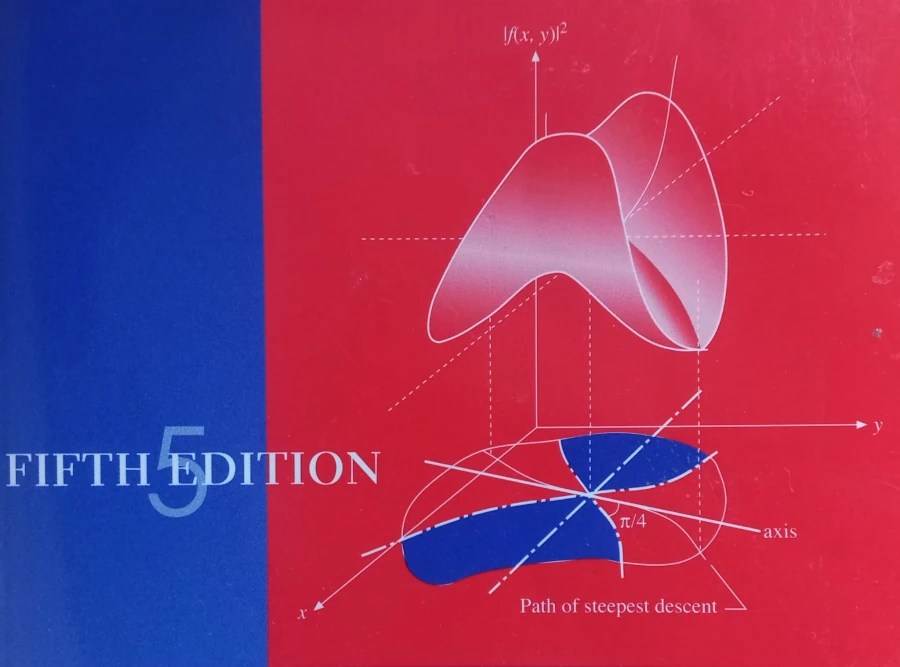
 Mathematical Methods for Physicists by George B. Arfken
My rating: 5 of 5 stars
Necessary background
– Integral calculus
– Trigonometry
– Some basic set and category theory
Contents
The theoretical minimum
– Vector analysis
– Tensor analysis
– Matrices and determinants
– Group theory
– Infinite series and expansions
– Complex analysis
– Differential equations
– Fourier analysis
More advanced methods
– Sturm Liouville theory
– Gamma-factorial function
– Bessel functions
– Legendre functions
– Special functions
– Integral transforms
– Integral equations
– Calculus of variations
Not covered
– Differential geometry (nothing more than co and contravariance which are covered in a single page)
– Numerical methods (some exercises urge you to code but no theory is given).
– Statistics
– Dimensionality reduction
– Classification
– Non-linear dynamics and chaos (Arfken’s final chapter on this is a joke).
Some thoughts
This is an excellent reference textbook and covers all of the mathematics you are likely ever going to need doing any physical science. It is more advanced and thorough than
Mathematical methods in the physical sciences by Boas which doesn’t cover a bunch of the topics above. However I don’t recommend Arfken if you’ve never seen a Hermitian matrix. What Arfken states in ten lines Boas will explain and provide intuition for across ten pages. This is actually precisely what I was looking for because I already have the intuition and just want a clear and concise overview with some exercises and physical worked examples.
Despite the large amount of content here Arfken barely covers any differential geometry which was disappointing. I bought Arfken as a reference book mostly. I’m doing GR right now and this is the first time Arfken has forsaken me.
If you are looking for a better understanding of non-linear dynamics and chaos theory this book is not for you. There are a handful of pages at the end of the book but I have not found these helpful. For that I’d recommend Nonlinear dynamics and chaos by Strogatz.
The book also doesn’t cover any numerical methods or statistics that will be vital to any experimentalist. There is no general statistics, hypothesis testing, confidence intervals, dimensionality reduction, classification or bayesian analysis. Since the book is already over 1k pages long this is understandable of course. Numerical methods by Grewal, Introductory statistics by Wonnacot and Probability theory by E.T. Jaynes may be useful texts to cover that.
View all my reviews



 Continental Hotspot
Leave a Reply