
Why does the center of mass of a Newtonian or highly relativistic object obey the motion expected from a Deep-MOND gravitational field acting on it? Shouldn’t the high internal accelerations prevent this in a sort of “internal field effect”? In short, no.
Mathematically, this is shown by considering a mass distribution ρ within a MOND field g0 and evaluating the force integral over a sufficiently large surface Σ. Using the Newtonian Gauss theorem, the integral simplifies to 4πGMg0, leading to the expected MOND acceleration F=Mg0, meaning the subsystem’s center-of-mass acceleration is identical to g0.
The detailed proof that the center of mass motion of a system adheres to the external field applied to the system even if it is a Deep-MOND external field can be found in the foundational work of Milgrom:
- For the AQUAL formulation of MOND see section IV. The center-of-mass motion of bodies in an external field in the 1984 paper.
- For the QUMOND formulation of MOND see section 5.3 Centre-of-mass acceleration of composite systems in the 2010 paper.
The necessary size of the surface Σ is given by the MOND radius:

Inside this radius all interactions can safely be treated as Newtonian and the center of mass will move like a billiard ball in a Milgromian field.
Some Newton-like intuition
The proof involving the surface integral mentioned above may not be very intuitive. Unfortunately it is the only fully accurate way of determining the motion of a center of mass regardless of the gravitational field strengths involved. However we may get some Newton-like intuition by considering the Milgromian potential of a point mass as if it simply consisted of two potentials that don’t switch off (aren’t screened):
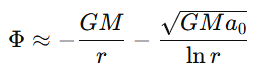
Then we simply add up the forces due to these two potentials for every object we are dealing with. This works reasonably well because in the Newtonian limit the first term dominates and in the Deep-MOND the second does.
Using this approximation is risky though. While this approximation is easy to understand, only doing the surface integral actually gives the right answer. There is a smooth transition between the Deep-MOND and Newtonian regimes at the characteristic acceleration scale a0 (Milgrom’s constant). The two-potential approximation overestimates the kinematic acceleration at a0 by a factor of two. Furthermore one has to choose the masses used carefully. You could divide up your masses in ever smaller bits and thereby artificially increase the force exerted since:

Some more intuition from GR

To get some more intuition that the center of mass (c.o.m.) can follow a path given by the external Deep-MOND field we only need to look to general relativity. GR, like MOND, is a nonlinear theory. If you double the mass of a neutron star or a black hole you do not double the acceleration at a given radius. You cannot just add up the contributions of each bit of mass using Newton’s Law of Gravity. Furthermore the effective force law falls off at a different rate than 1/R2. As we can see from the following example of one of the non-zero Christoffel symbols:

Now imagine a hierarchical triple system consisting of a highly relativistic neutron star binary with a third star at a distance away exerting an ordinary Newtonian gravitational pull on the binary. GR tells us that the binary c.o.m. moves according to the Newtonian gravitational pull of the third star. GR and MOND are similar this way.


Leave a Reply