
Tides in MOND work the same way they do in Newtonian gravity, just with the stronger Milgromian gravitational field. But before we can get to that we need to make clear that the tidal force and the external field effect are two different things (even though they can occur simultaneously).
The tidal force
- Results from a non-uniform gravitational field
- Stretches and squishes mass
- Occurs in Newtonian gravity, MOND and GR
- Can occur regardless of what gravitational regime the object is in
The external field effect
- Occurs even in a uniform field
- If the field is uniform there will be no stretching and squishing
- Does not occur in Newtonian gravity or GR
- Yields the quasi- & forced-Newtonian regimes
In MOND tides are determined by the non-uniformity of the Milgromian gravitational field. So this has to determined first from the mass distribution or from the Newtonian gravitational field before the tides can be determined.
Despite the traditional name the tidal force has units of acceleration. To calculate the tidal force one integrates the tidal tensor over the desired area.The nonrelativistic tidal force is defined fully by the tidal tensor:
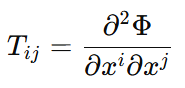
The Newtonian tidal force
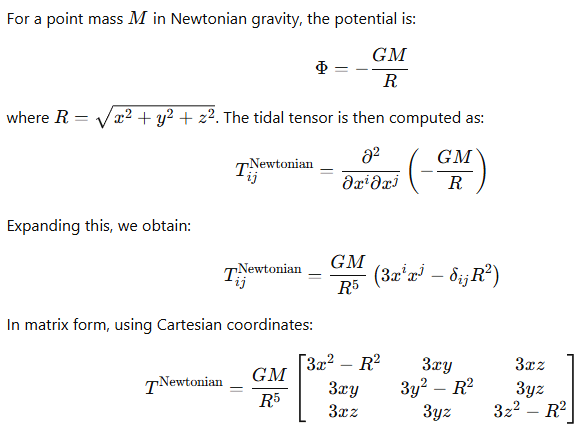
For Newtonian gravity this tidal tensor becomes:

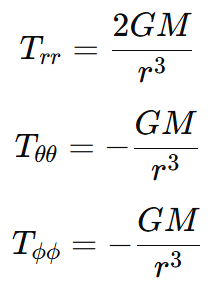
When we are dealing with a single point mass in spherical coordinates this simplifies to:
Derivation of the Newtonian tidal tensor
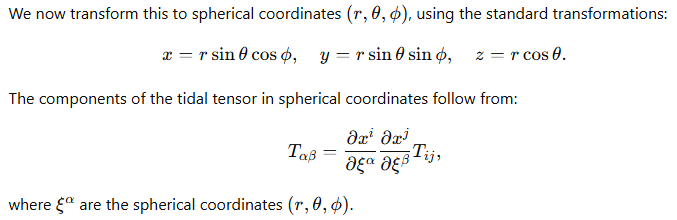
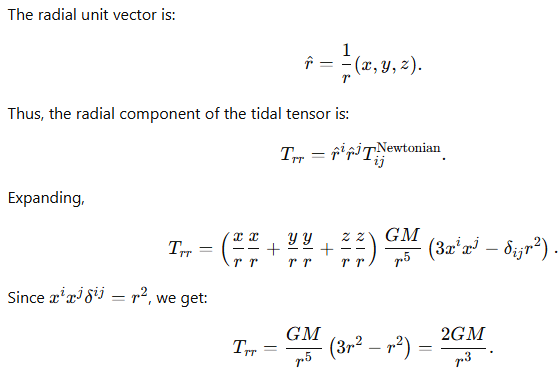
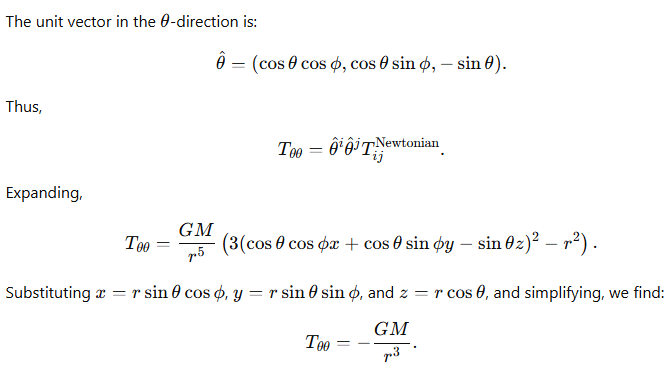
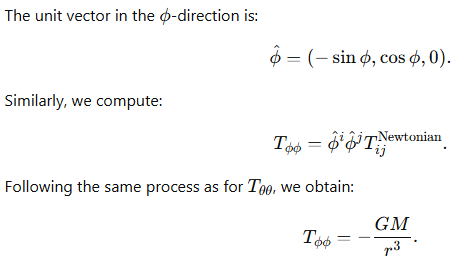
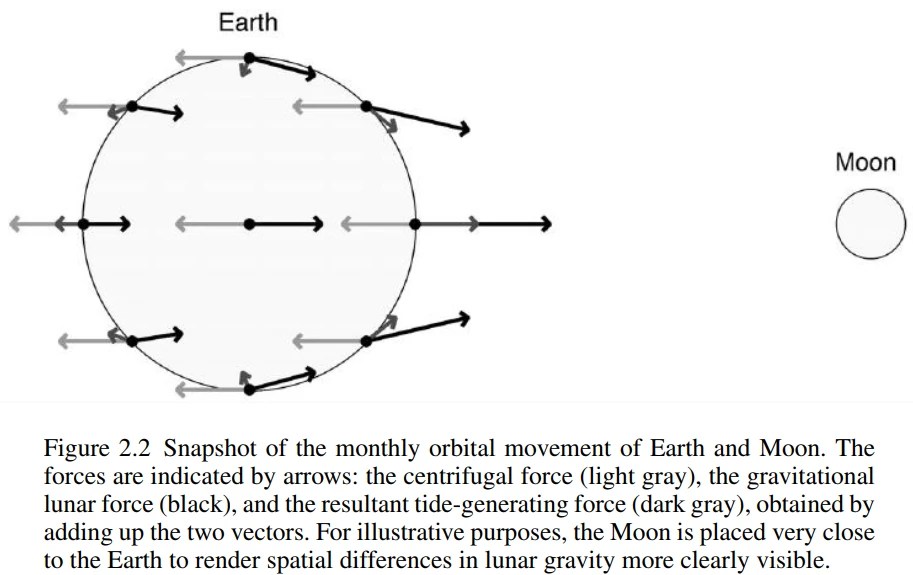
Furthermore the tidal forces throughout an object can be determined numerically as follows:
- Calculate the gravitational acceleration of the source at the center of the object experiencing the tide.
- Determine the centrifugal acceleration. This is simply the same vector with its direction reversed (this is because these two must cancel out in order for the system to be stable).
- Calculate the gravitational acceleration of the source at every point of interest and vectorially subtract the centrifugal force from it. The resulting vectors are the accelerations of the tidal “force”.
This procedure is illustrated in the figure below (see also Ch.2 of Gerkema, 2019).
The Milgromian tidal force
In MOND the numerical procedure is identical except one uses the Milgromian gravitational field instead of the Newtonian one. If this is not already known from the matter distribution it can also be determined from the Newtonian field using QUMOND, either analytically or for any arbitrary matter distribution using numerical codes such as Phantom of Ramses.
For an analytical analyses we once again use the tidal tensor. We assume we are only dealing with the Deep-MOND regime. The tidal tensor for MOND then equals:
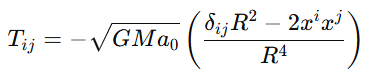
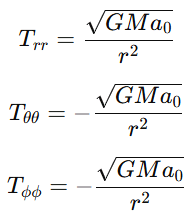
When we are dealing with a single point mass in spherical coordinates this simplifies to:
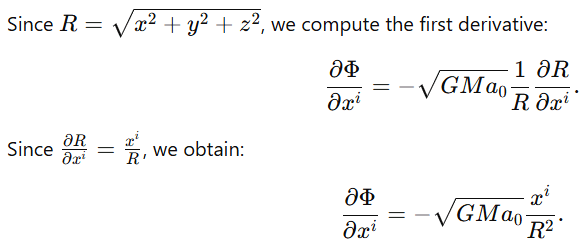
Derivation of the Milgromian tidal tensor
The potential of a point mass in the Deep-MOND regime equals the following (we can assume the constant of integration C=0):

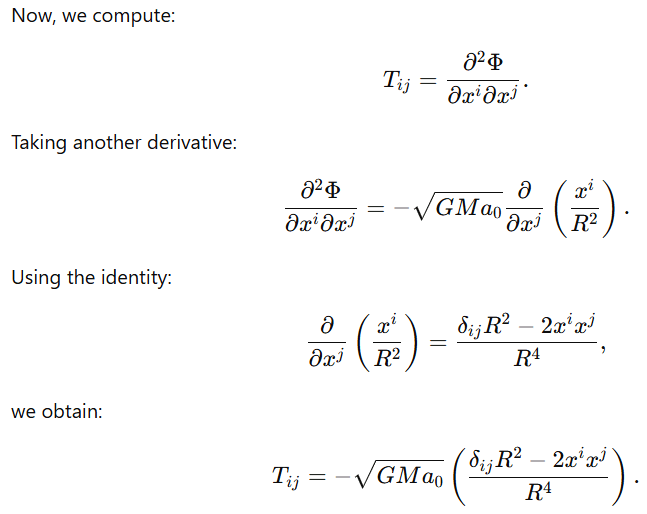
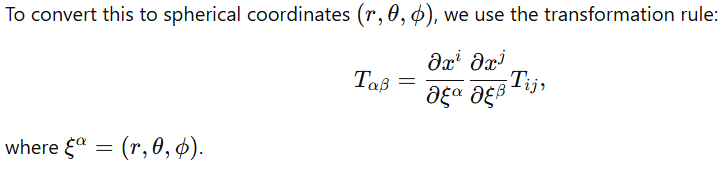
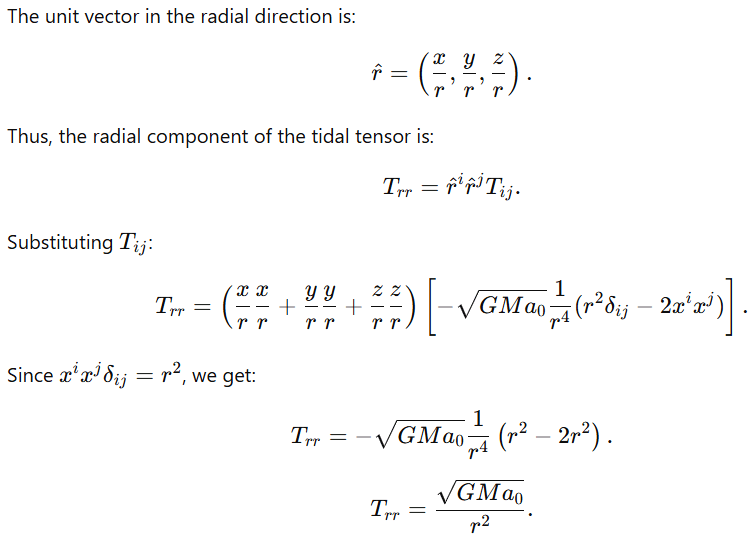
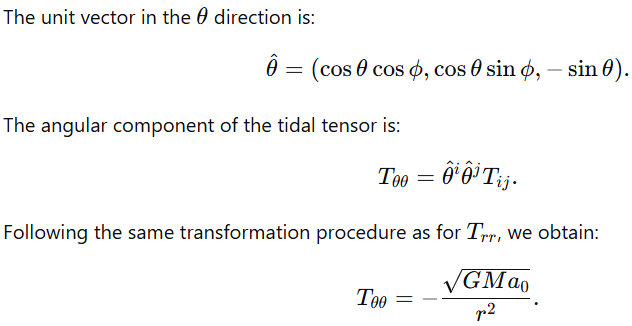
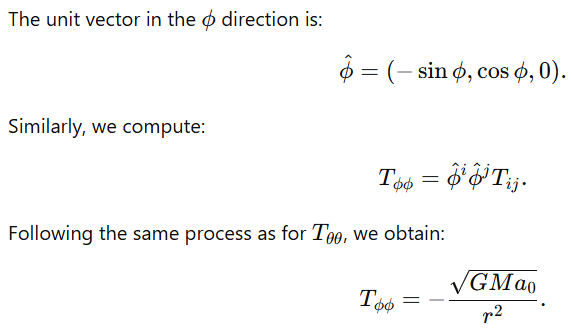
As can be seen from the Milgromian tidal tensor, the tides have the same magnitude regardless of direction. This is different than in Newtonian mechanics where the tides in the stretching direction are stronger than the tides in the compressive direction by a factor of 2. In MOND tides cause a net compression of an object given enough time whereas in Newtonian gravity the total volume stays the same. Tides are also stronger overall due to the increased gravitational field. Furthermore for systems in which the tidal force does not change much over the size of the object (which are small compared to the distance to the tidal source) there should be no dependence on the angle between the line of sight and the gravitational force vector.



Leave a Reply