
An accusation that can be levelled against any theory is that it gets the data wrong (underfit) or that it has too much flexibility and can fit anything (overfit). MOND is a rather restrictive theory and as a consequence the underfitting argument is most often levelled against it. There is some merit to this as we’ll see in the post on the cluster conundrum. However one should also check for overfitting. Here MOND shines.

The three cases above probably already show clearly why you don’t want to overfit your data. By fitting the available data extremely well, new data that slightly falls off the line will disprove the model because the model is too detailed. Of course you could adjust the fit to incorporate the new data just as well as the old data if your model is flexible enough. But that doesn’t lead you to being able to predict new measurements properly. Put another way:
The usefulness of a model is not what it can explain, but what it can’t. A hypothesis that forbids nothing, permits everything, thereby fails to constrain anticipation.
Your strength as a rationalist is your ability to be more confused by fiction than by reality. If you are equally good at explaining any outcome, you have zero knowledge.
And that is precisely what De Blok and McGaugh checked in 1998 for both MOND and dark matter. They combined the mass distribution from the galaxy U128 with the rotation curve from NGC2403 in the graphs below. For the test they calculated the expected MOND rotation curve from the U128 mass distribution and we can clearly see that it doesn’t match the data from NGC2403. This is good. MOND tells you that you are doing something wrong. Changing the one free parameter, the mass-to-light ratio only stretches the MOND prediction given by the black line up or down. So changing the free parameter does not get you a good fit for any value.
Then they modelled the dark matter. There is no equivalent to a Milgrom’s law in dark matter theory. So one can only compare the matter distribution and the dynamics using Newtonian gravity and then add a smooth distribution of dark matter that makes up the difference. This is fine if your data is real. There are usually two or three parameters you can tune to get a decent fit. But in this case the two data sets don’t belong together. Dark matter models don’t tell you this. Consequently you can produce a dark matter “rotation curve” that goes through the rotation curve data from the wrong galaxy.
MOND won’t fit fake data
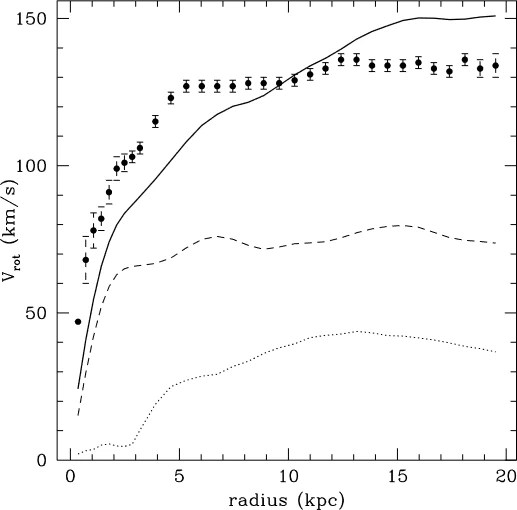
DM allows fits to fake data
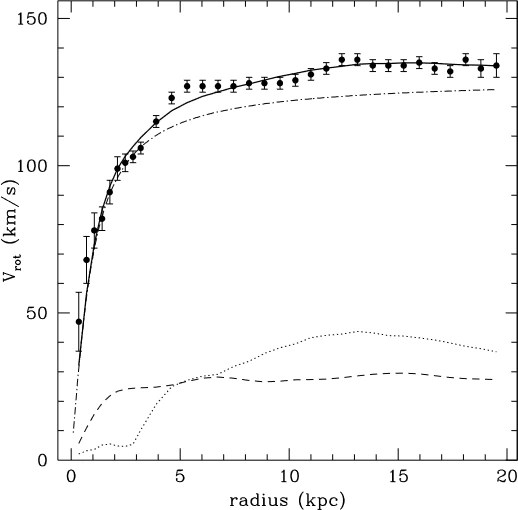
Theories should be able to distinguish between real data and made up nonsense. MOND does that. Dark matter does not.



 Continental Hotspot
Leave a Reply