
Often the scientific literature is rather dry, boring and hard to understand. So it isn’t every day that you come across some pure unadulterated sass. But that’s exactly what we’ve got with the spat between Rodriguez et al. and Li et al.
Several years ago Davi Rodriguez and friends published a very controversial paper claiming that Milgrom’s constant a0 does not exist. They did this by applying advanced Bayesian statistics to the very SPARC database that had been used to establish Milgrom’s constant. A flurry of pithy replies and rebuttals followed. All in all this unusual outburst of academic conflict spans at least nine papers, comments, replies and letters to the editor.
The full list
- Rodriguez et al.: Absence of a fundamental acceleration scale in galaxies
- Kroupa et al.: A common Milgromian acceleration scale in nature
- McGaugh et al.: Presence of a fundamental acceleration scale in galaxies
- Rodriguez et al.: Reply to ‘Presence of a fundamental acceleration scale in galaxies’ and ‘A common Milgromian acceleration scale in nature’
- Angus et al.: Overconfidence in Bayesian analyses of galaxy rotation curves
- Rodriguez et al.: Reply to: Overconfidence in Bayesian analyses of galaxy rotation curves
- Rodriguez et al.: A fundamental test for MOND
- Rodriguez et al.: The radial acceleration relation and its emergent nature
- Li et al.: A cautionary tale in fitting galaxy rotation curves with Bayesian techniques: Does Newton’s constant vary from galaxy to galaxy?
Ultimately Rodriguez et al. were resoundingly rebutted on a dozen different aspects of their analysis. The main criticism was their use of a black box Bayesian fit to the data which allows a computer to fit a bunch of different variables at the same time. In principle this is an unbiased method of analysing data however whether this actually works all depends on the boundary conditions (so called “prior probabilities” or “priors”) that one chooses for the model. By not constraining parameters with Gaussian priors, using flat priors instead, Rodriguez et al. allowed their model far too much wiggle room.
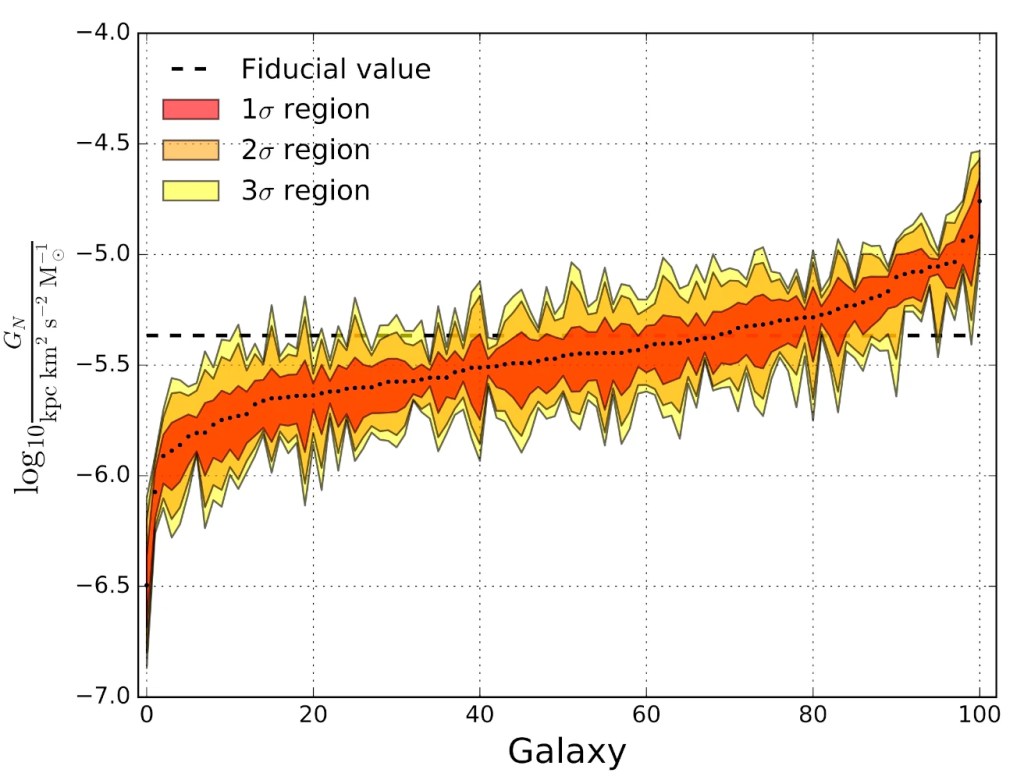
That sounds technical, but now for the sass. Li and collaborators used the exact same supposedly superior Bayesian technique as Rodriguez et al. but instead of testing for Milgrom’s constant as Rodriguez et al. had done, Li and collaborators tested for the existence of Newton’s constant. Newton’s constant was shown “not to exist” either. Because Newton’s constant is an extremely well established constant that is vital to both Newtonian gravity and General Relativity this shows that the methodology of Rodriguez et al. is deeply flawed.
Li et al. even replicated the key plot but now for Newton’s constant:
Milgrom’s constant

Newton’s constant
Professor Stacy McGaugh has already done two detailed write-ups on this so I’ll leave it at that and simply refer you there if you want to know more:



 Continental Hotspot
Leave a Reply