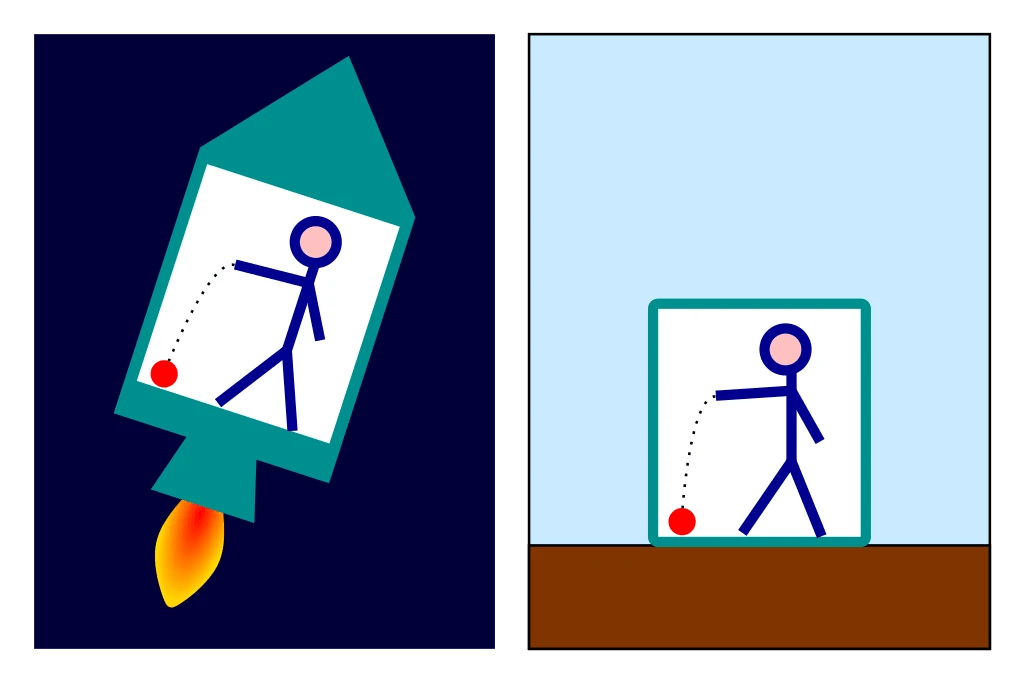
The equivalence principle is a fundamental part of Einstein’s theory of General Relativity which is currently our best theory of gravity. Breaking this almost sacred principle is often seen as an immediate strike against a theory so it is reasonable to ask whether MOND does so. To find that out we have to first distinguish which equivalence principle we are talking about. There are at least four distinct principles: the Newton equivalence principle (NEP), the weak equivalence principle (WEP), the Einstein equivalence principle (EEP) and the strong equivalence principle (SEP). We’ll discuss these in turn and see how MOND relates to each.
Newton equivalence principle
NEP: “In the Newtonian limit, the inertial and gravitational masses of a body are equal.“
This equivalence principle states that the mass you measure if you push the car equals the mass you measure if you try to lift it. MOND requires the NEP to be valid.
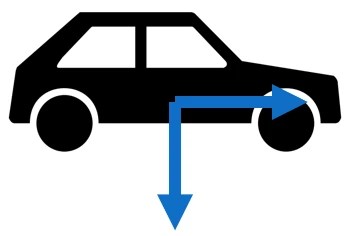
Milgromian dynamics as it is explained in this FAQ guide obeys this equivalence principle in all cases. Because MOND is a modification of our laws of gravity and not of anything else the inertial and gravitational mass are assumed to be the same in MOND.
That is not to say that there aren’t modified inertia theories that produce MOND-like behaviour. In fact Mordehai Milgrom has also proposed theories like that. But modified inertia theories are not worked out in more than a couple papers and produce non-local effects for which there is no evidence. Modified inertia theories are also rather complex because of this non-locality and getting clear predictions is challenging. As a consequence modified inertia theories are wholly unpopular.
Weak equivalence principle
WEP: “Test particles with negligible self-gravity behave, in a gravitational field, independently of their properties.“
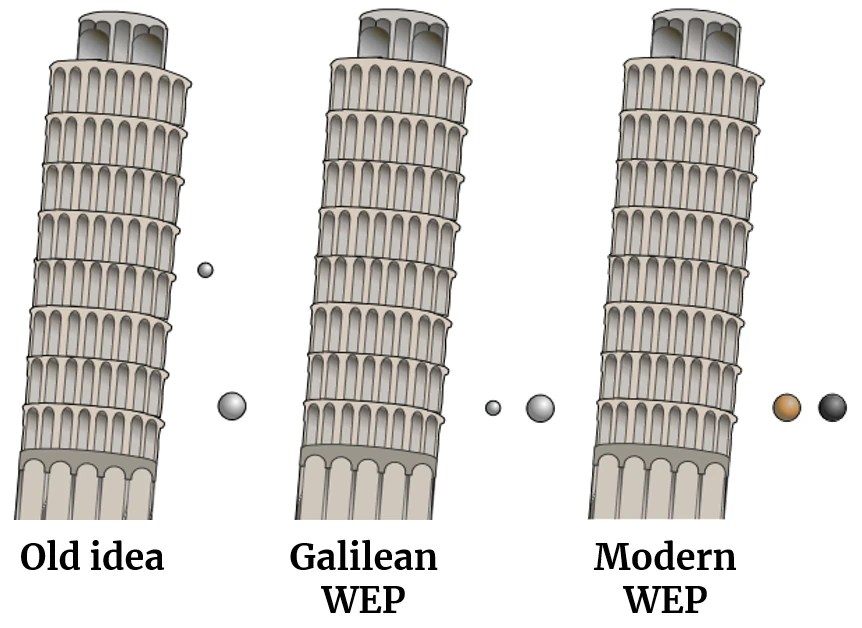
The WEP means that objects all fall at the same speed under the same gravity (if we ignore air resistance which may differ). In the olden days of Greek philosophy, particularly in the thinking of Aristotle, people thought that heavier things fell faster. All things had their accustomed place where “they wanted to be” which is why rocks sink in water but wood doesn’t, why smoke and fire rise and why air is above the water and the earth. This thinking was challenged by many in the 16th century but by none more famously than by Galileo Gallilei.
Galileo came up with a thought experiment where one would drop two lead balls with different masses from the leaning tower of Pisa and observe them fall. Aristotle would have claimed that the heavier ball would reach the ground first but according to Galileo both balls would reach the ground at the same time. Now there’s no evidence that Galileo actually ever really performed this experiment and this story is at least partly apocryphal like Newton and his apple. However the experiment was performed in real life by Dutch physicist Simon Stevin from the New Church in Delft. Apollo astronauts also performed this experiment on the Moon (see the video below). Modern versions of this principle also include the two objects being the same mass but different in composition.
MOND requires the WEP to be valid. So far there is no evidence that the WEP is incorrect.
Einstein equivalence principle
EEP: “Fundamental non-gravitational test physics is not affected, locally and at any point of spacetime, by the presence of a gravitational field.“
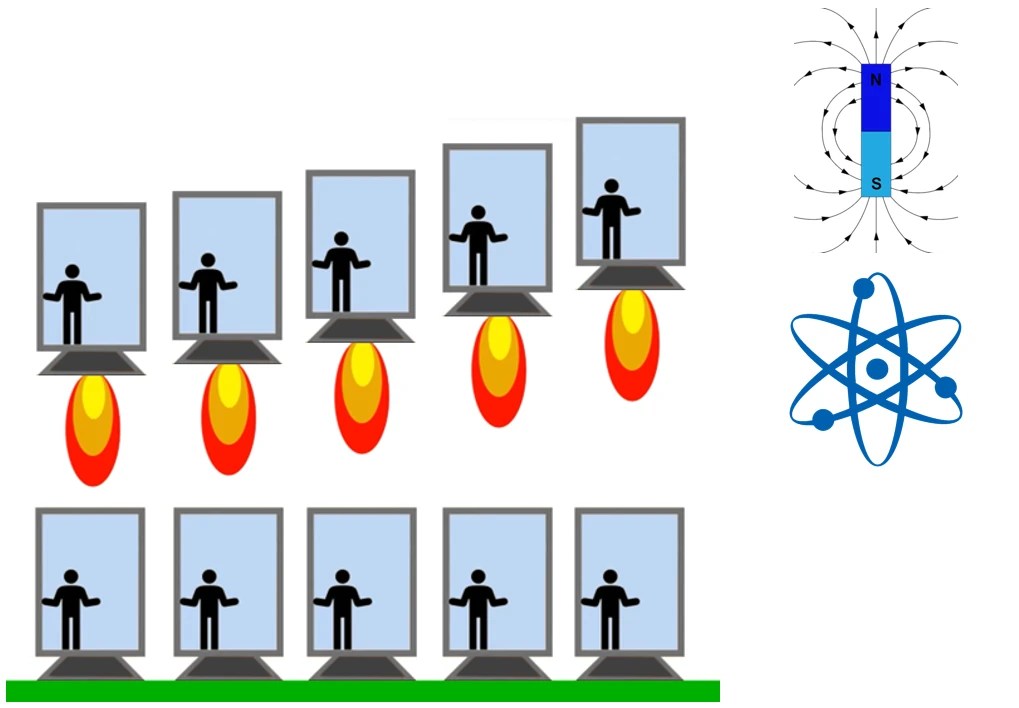
In other words the EEP states that you can’t tell whether you are in a rocket or an elevator going up or standing still on a planet (if you ignore the vibrations any real engine would cause of course). No experiment using the forces of electromagnetism, the weak nuclear force or the strong nuclear force can distinguish between being accelerated by a gravitational field or by some other force pushing you. The same is true for free fall and simply floating in deep space. If you can’t look outside, you can’t tell the difference.
MOND requires this equivalence principle to be true.There is no evidence whatsoever that shows this principle to be false, although one may have to define the term “locally” to be sufficiently small that one’s rocket module isn’t affected by tidal forces (due to non-uniform gravity).
Strong equivalence principle
SEP: “All test fundamental physics (including gravitational physics) is not affected, locally, by the presence of a gravitational field.“
This equivalence principle is the same as the EEP except now we also include gravitational tests such as Cavendish experiments. And it is here that Milgromian dynamics finally departs from GR when it comes to equivalence principles. While for gravitational fields above a0 the SEP is followed, this is not the case below a0.
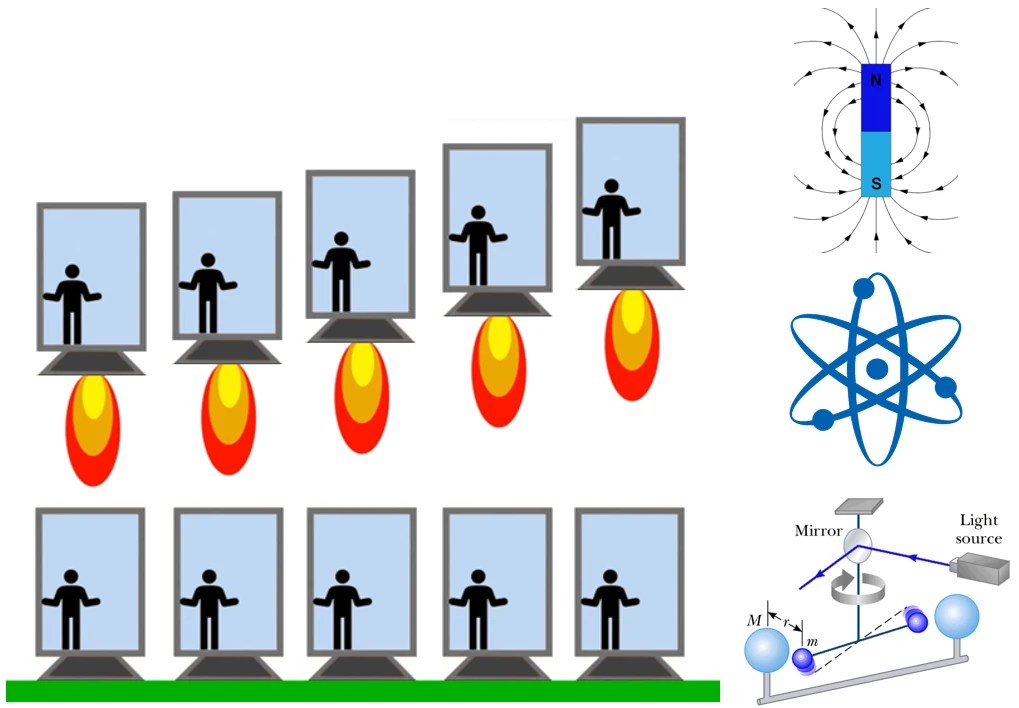
If one performs a Cavendish experiment with accelerations below a0 in our box then the experiment can tell you whether you are on Earth or in deep space without looking outside. There is considerable astrophysical evidence for this violation of the SEP. Check out the following post on the external field effect for an explanation how that works and a list of the evidence for it:
6. What is the external field effect?
For the laboratory tests of the SEP on earth see:
19. Do laboratory tests rule out MOND?
Testing the SEP in the strong gravitational limit
In the late 2010’s some amazing research was published testing the SEP in the hierarchical pulsar system PSR~J0337+1715. This does not constrain MOND because it does not test very weak gravitational accelerations but it does put strong constraints on possible gravitational theories in general. Anne Archibald, one of the lead investigators on this project, has given two talks available on Youtube where she discusses this. The first is a Astronomy on Tap talk which is at the level that should be understandable if you’ve consumed a number of alcoholic beverages. The second is a more serious lecture with a Q&A session at the Marcel Grossmann meeting in Rome. Both are well worth watching if you are interested in understanding how gravity works.
In summary
Whether the ExFE in MOND violates the equivalence principle depends on which equivalence principle one talks about.
MOND follows:
- Newton equivalence principle (NEP)
- Weak equivalence principle (WEP)
- Einstein equivalence principle (EEP)
MOND sometimes does not follow:
- Strong equivalence principle (SEP), but if and only if total gravitational accelerations are below a0 (else it holds).
Since GR is believed to be the only theory of gravity which respects all four equivalence principles and MOND is a different theory of gravity it is not surprising that MOND does break equivalence. However MOND breaks equivalence only in a very limited and restricted way. The limits placed on the violation of the strong equivalence principle by systems such as lunar laser ranging and the hierarchical triple pulsar system PSR~J0337+1715 have gravitational field strengths well above a0 so would not be expected to show anything other than ordinary GR from the perspective of Milgromian dynamics. So these constraints do not constrain MOND.



 Continental Hotspot
Leave a Reply