
In short, yeah pretty much. MOND (Modified Newtonian Dynamics) is not a relativistic theory, meaning it does not provide a framework for cosmology or make direct predictions about the cosmic microwave background (CMB). It is a non-relativistic of Newtonian gravity. So MOND only applies to those phenomena which can be described without using the FLRW metric. Several relativistic extensions of MOND have been proposed to address cosmology however. These extensions tend to be more complicated than LCDM though.
Sean Carroll lays it out for us
Sean Carroll lays out the problem for MOND with the CMB quite clearly. If we assume the same scale-factor for the universe at the time of the surface of last scattering (assumed to be at z~1100 using LCDM) the universe is too dense to be in the deep-MOND regime. Therefore we should not see any deviation from Newtonian gravity and hence no enhanced third peak in the power spectrum. Yet we do see a high third peak. See his talk on the subject:
What “MOND” instead predicted (a no-CDM, high-Λ GR run using LCDM software for CMB spectra) along with subsequent measurements:

The first two peaks are predicted very well unlike LCDM at the time. But LCDM changed some parameters and now fits the entire spectrum while MOND is still stuck at this. This is typical of the modified gravity vs. dark matter discussion. MOND makes some successful predictions before the measurements are in about a small part of the data but then fails to improve whereas LCDM is flexible enough to fit all the data.
At the recent MOND conference I heard an interesting analogy for this process. Imagine MOND and LCDM are kids in school and their teacher is Nature. Nature hits them with a surprise test and MOND actually gets answers right. LCDM hands in an empty sheet of paper. Nature somewhat frustratedly explains the subject matter again and now LCDM hands in the full exercise, nearly all answers correct and gets and A. MOND meanwhile hands in the same answers as last time and gets a D– or an F.
AeST
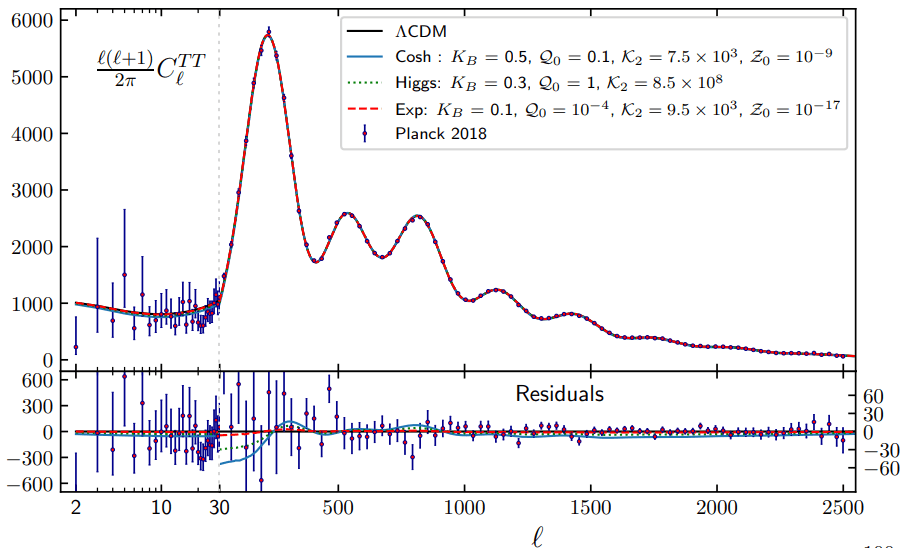
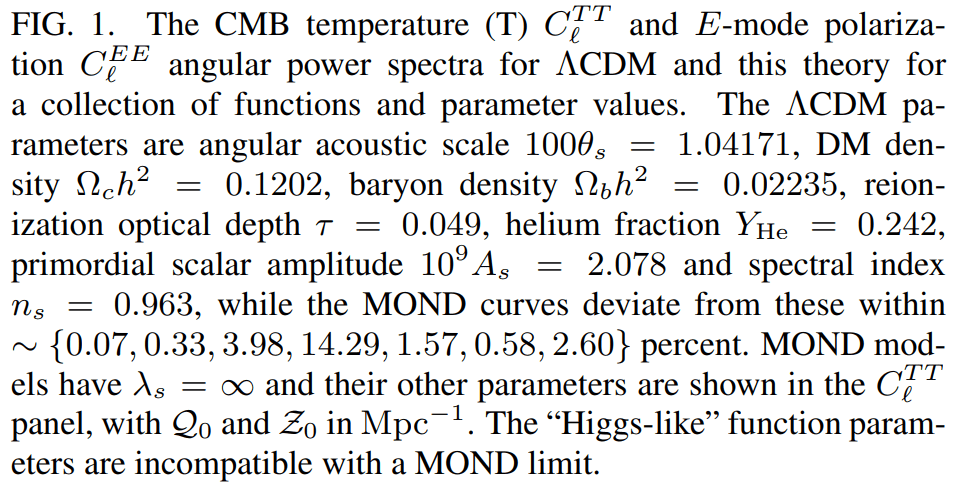
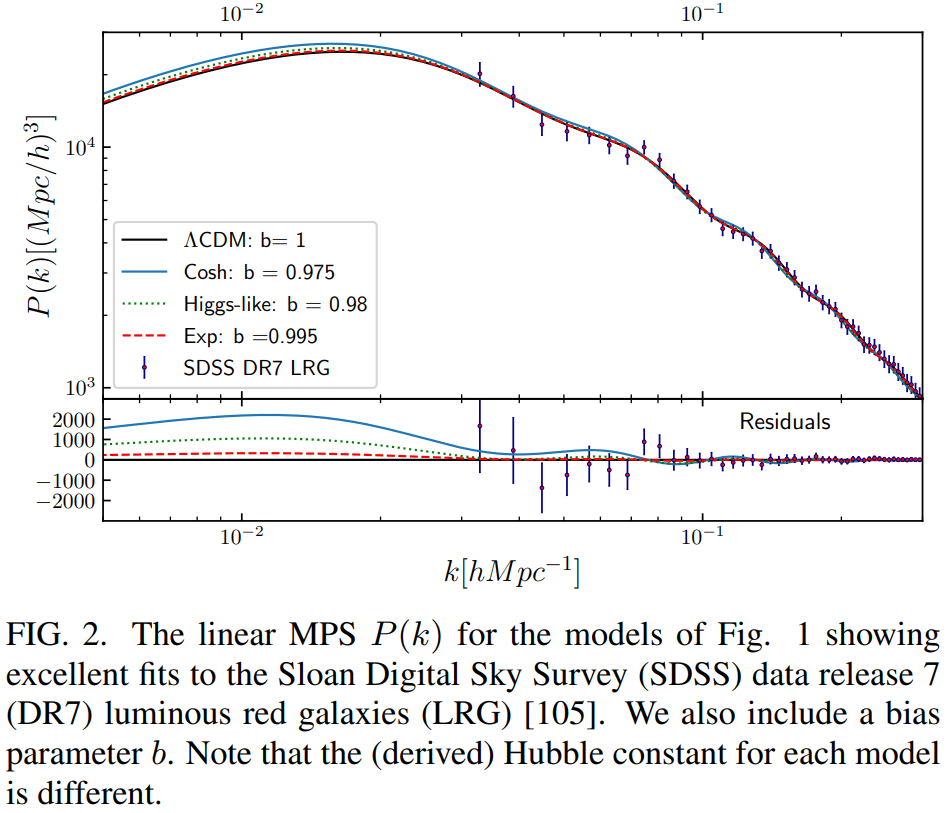
A modern extension of MOND called AeST (Aether-Scalar-Tensor theory), provides a relativistic formulation that fits CMB observations reasonably well. Thus demonstrating that MOND-like dynamics can be embedded in a broader theoretical framework compatible with cosmology. To do so AeST does require four different parameters which makes it more complicated that LCDM and essentially introduces a form of dark matter in a roundabout way. So whether such extensions can become as useful as LCDM for doing cosmology is doubtful. But at least MOND extensions can fit the CMB and the matter power spectrum. Two decades after LCDM did it but it’s something..

See also:


 Continental Hotspot
Leave a Reply