To those unfamiliar with MOND it may seem that rotation curves of spiral galaxies are all MOND is capable of predicting (yes, not fitting!). However, there are many other types of evidence that support MOND. We’ll go through the main ones here:
Strong lensing
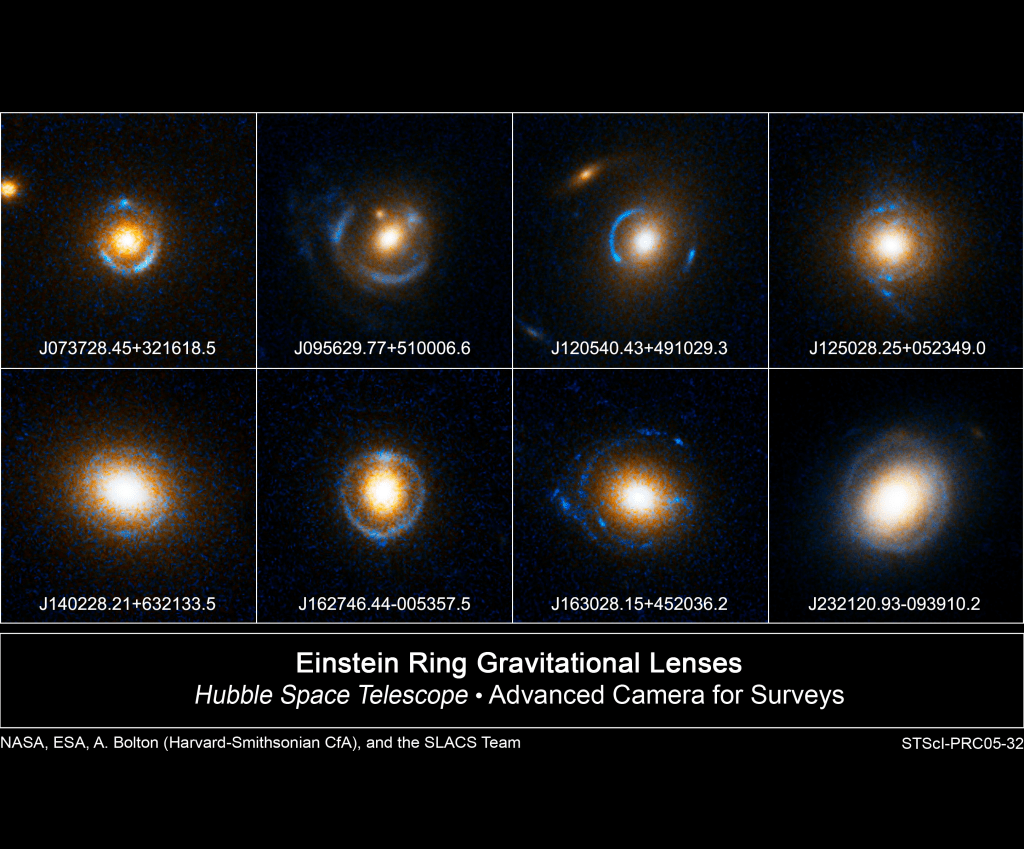
Despite MOND not being a relativistic theory we can still check whether lensing confirms Milgrom’s Law by measuring Einstein rings. Einstein rings are circular images of distant galaxies or stars formed when their light is bent by the gravity of a massive object, like a galaxy, lying directly between them and the observer. This phenomenon, predicted by Einstein’s theory of general relativity, is a striking example of gravitational lensing. By measuring the radius of the ring and the amount of light being emitted by the lensing object we get two measurements of the gravitational potential at the ring. Just like a rotation curve this gives us a dynamical and a baryonic measurement of the gravity which has been plotted below. As we can see strong lensing (blue) agrees very well with measurements of rotation curves (green).
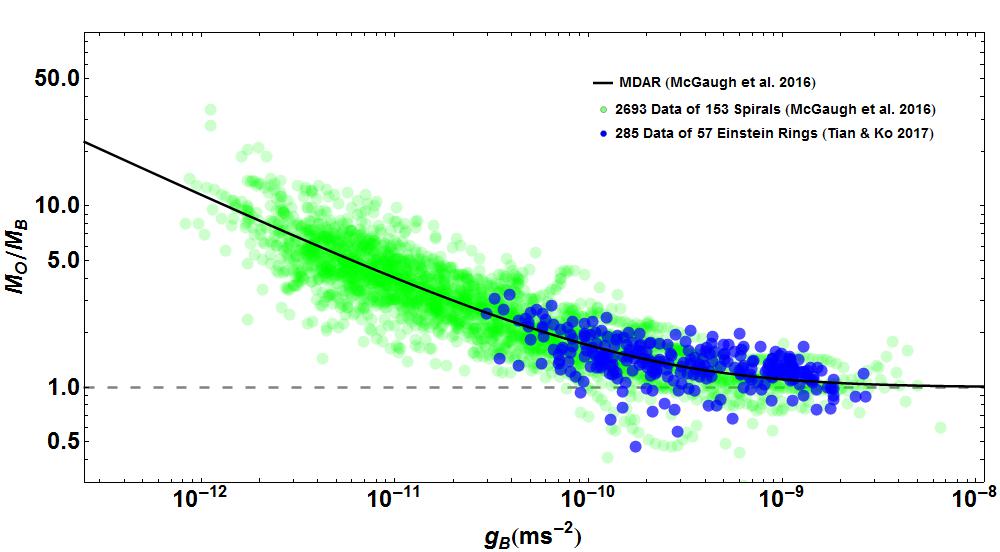
For more on this read Tian & Ko 2017.
Weak lensing
Weak lensing is a subtle effect where the light from distant galaxies is slightly stretched and sheared as it passes through the gravitational fields of intervening large-scale structures. This distortion is too small to see in individual galaxies, but by analyzing the shapes of many galaxies across a region of the sky, astronomers can map the distribution of mass in the universe. By measuring the weak lensing shear around thousands of very isolated galaxies one can measure the average dynamical gravity of these isolated galaxies. Paired with measuring the light to get the average baryonic mass we can clearly see that weak lensing follows Milgrom’s Law (a.k.a. the radial acceleration relation).

For more on this read Brouwer 2021 and Mistele 2024.
Galactic bar pattern speeds
Further evidence for MOND comes from the study of galactic bars. The paper “Fast galaxy bars continue to challenge standard cosmology” examines the dynamics of barred spiral galaxies and finds a persistent discrepancy between observations and predictions made by simulations based on the ΛCDM (Lambda-Cold Dark Matter) model. In the ΛCDM framework, galaxy bars are expected to slow down over time due to dynamical friction with their host galaxies’ dark matter halos. This results in “slow bars,” where the corotation radius (where stars move at the same angular velocity as the bar) lies well beyond the end of the bar. However, observations consistently find “fast bars”—bars that nearly reach their corotation radius. The study compares bar dynamics in real galaxies with those from high-resolution ΛCDM simulations, including IllustrisTNG and EAGLE, and finds significant statistical tension, with the simulated bars rotating much more slowly than observed, with deviations reaching up to 13σ in some cases.
In contrast, Modified Newtonian Dynamics (MOND) simulations, which lack dark matter halos, naturally produce fast bars that align well with observations. The authors argue that this ongoing mismatch between observed fast bars and simulated slow bars challenges the core assumption of massive dark matter halos in galaxies. Despite attempts to address the discrepancy through improved resolution or different numerical methods, the ΛCDM simulations fail to reproduce the observed distribution of bar speeds. This suggests either a fundamental misunderstanding of galaxy dynamics within the ΛCDM paradigm or strong support for alternative theories like MOND, which do not suffer from bar-slowing via dynamical friction.
Dwarf spheroidal galaxies
Dwarf spheroidal galaxies are excellent laboratories for testing gravity because they are dark-matter-dominated (under ΛCDM) and have extremely low internal accelerations, making them sensitive to deviations from Newtonian dynamics. Their velocity dispersion profiles can reveal whether modified gravity theories like MOND better explain their dynamics without invoking dark matter. Additionally, their proximity and abundance around the Milky Way allow for statistical comparisons that test the consistency of gravitational models across different environments.

Professor Stacy McGaugh has done most of the work on this and has written a series of in depth blogs which are a great introduction to the topic:
Structure formation of the universe
Matter in the universe has been shown to clump together far faster than LCDM predicts (orange line below) but matches well with a monolithic collapse to form galaxies as expected by MOND (purple line). See the recent work by Stacy S. McGaugh, James M. Schombert, Federico Lelli, and Jay Franck.

This paper is summarised for the lay audience in this series of blog posts over on Triton Station:



 Continental Hotspot
Leave a Reply