
With this post I’m kicking off a series on the debate between modified gravity and dark matter. I’ll focus on answering the most frequently asked questions about modified gravity, specifically Mordehai Milgrom’s theory of modified gravity called MOND (or Milgromian dynamics). There’s tons of stuff about dark matter already but a good introduction to MOND is lacking.
So what’s this modified gravity vs. dark matter thing even about?
How matter ought to move
Humans have been looking at the heavens since before records began. Only in recent centuries has science caught up enough with our curiosity to actually understand what we are looking at. Big names such as Copernicus, Kepler and Newton explained how and why planets in the heavens move. By now we all know the answer: the planets go around the sun because of the force of gravity. Similarly the Moon goes around the Earth and other moons go around their planets. Gravity is also why things fall down the way they do.
Newton even gave us precise laws we can use to calculate how this plays out with his Law of Universal Gravitation:

This is something most people will have seen at some point during high school. Two objects attract each other proportionally to their own mass. The further the two objects are apart the less this attraction is.
This breakthrough by Newton unified two previously unknown phenomena, things falling down on Earth and objects orbiting each other in space. Newton illustrated this with his famous thought experiment called “Newton’s Orbital Cannon”, see the image below.

This thought experiment is simple. Suppose you put a cannon high up on a mountain and you fire the cannon horizontally. The cannonball will travel a certain distance sideways determined by the velocity of the cannonball. The faster the cannon fires the cannonball the further the cannonball will get. According to Newton’s law there is a velocity at which the cannonball goes so fast that it will fall around the Earth in what we call an “orbit”. This is precisely what happens to the Moon. It is attracted by the gravity of the Earth but due to its sideways motion it falls around the Earth instead of straight toward it.
For objects going around the sun Newton tells us that the further a planet is from the Sun the slower it ought to move orbit stably. Since basically all the mass of the solar system is in the Sun this slowdown should look like the very regular graph below. We call this a rotation curve because it describes the rotation speed around a central point.
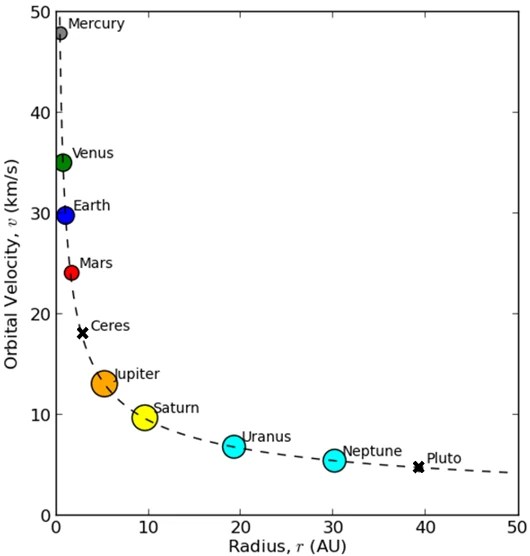
Objects with circular velocities and distances from the sun that put them on the dashed line stay in orbit around the sun forever (since there’s no friction in space to slow them down). If an object were above this line it would be going too fast to be stable. It would either expand its orbit or leave the solar system entirely. Below the line and the orbit would contract and the object might even be destroyed as it falls too far towards the sun.
Galaxies are misbehaving
The situation in galaxies is slightly more complicated than in the solar system because the mass of the galaxy is more spread out instead of concentrated in one spot. So initially we expect to see a rise in the orbital velocity as we travel outwards from the center of the galaxy. Only once you get out to a certain radius and most of the mass is behind you towards the center of the galaxy should we see the same velocity fall off as in the solar system (this is called Keplerian decline of the rotation curve).
However this expected situation is not what we observe. Instead of a declining velocity (see the left animation and graph below) we see that the rotational velocity becomes constant towards the outer galaxy.
←Expected
Observed →

This is very strange because we can’t see enough mass in only the gas and stars to explain this using our ordinary laws of gravity by Newton and Einstein. The outer edges of galaxies are moving so fast they ought to be catapulting stars and gas into deep space. Yet galaxies appear to be stable because we can see they have existed for billions of years (based on the time the light had to travel, as well as the ages of the stars themselves).
Clusters of galaxies too
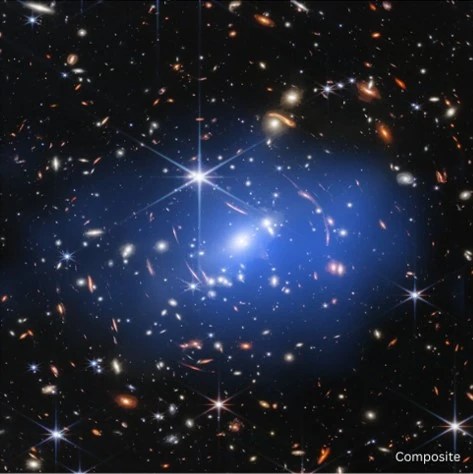
An it’s not just galaxies either. On much bigger scales there exist large balls of hot gas with sometimes up to thousands of individual galaxies clumped together. These systems are called galaxy clusters and these too are behaving strangely. In these galaxy clusters the gas is too hot and the galaxies are orbiting the middle way too fast. These large balls of stuff should be exploding apart because of the internal velocities. Yet these galaxy clusters seem to be stable too.
The universe is too clumpy
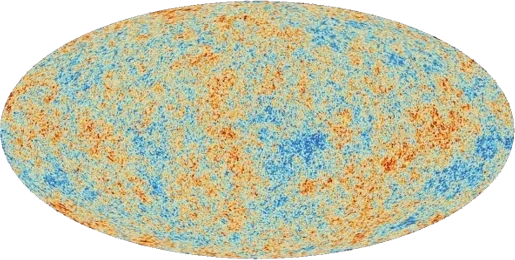
From statistical descriptions of the baby picture of the universe (the power spectrum of the Cosmic Microwave Background) we know that the universe began in an incredibly uniform state that got progressively clumpier over time. This is confirmed by mapping the distribution of galaxies over time (this is possible because the speed of light is finite, so the further away you look the older the observed objects are). But here too we find that the gravity caused by ordinary matter in gas and stars is not sufficient to get us from that very uniform beginning to the present if we assume our current theory of gravity is correct.

Light isn’t bending right either

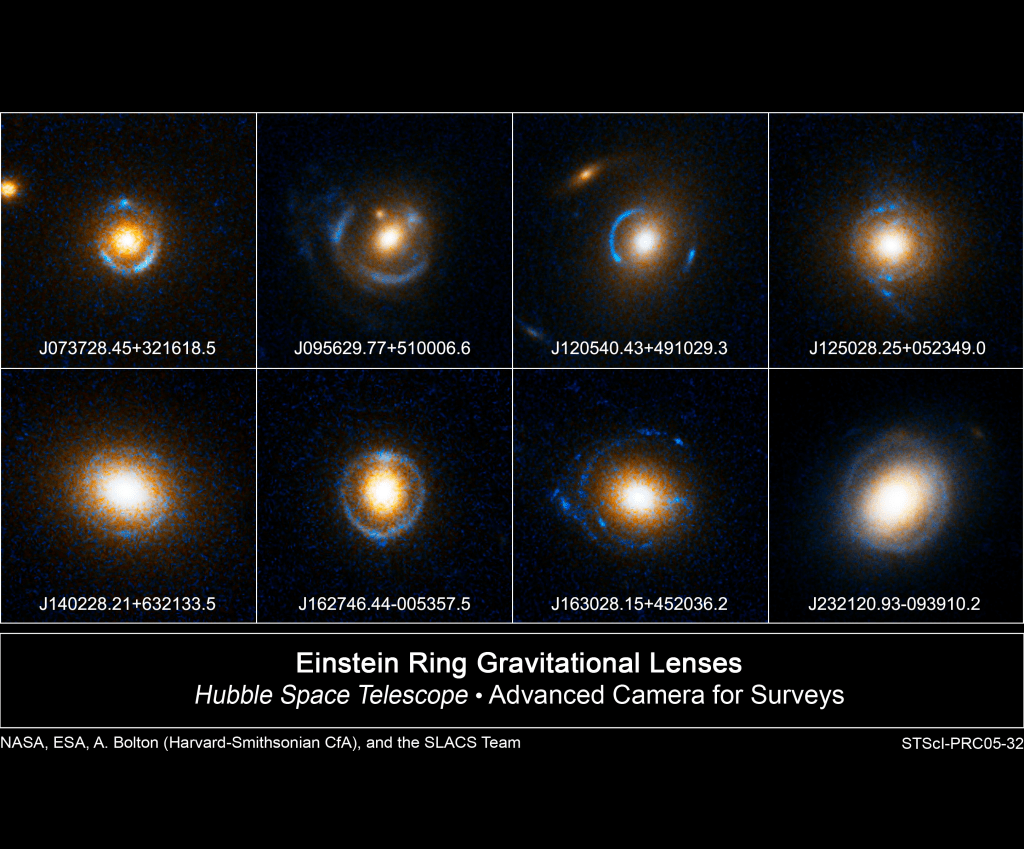
And it gets stranger. Using Einstein’s theory of General Relativity astronomers can also calculate that there’s a problem with a phenomenon called gravitational lensing. As you can see in the image above when objects such as galaxies or entire clusters of galaxies get really massive they actually bend light around them by curving spacetime. This effect is far too small to see in everyday life but on the scales we’re talking about here it can be measured precisely. And the amount of bending is far too much for the matter we can see in the stars and gas. So finally what we see here is not what we get from our theory of gravity and the mass we can observe either.
A history lesson
Interestingly we’ve been here before. In the 19th and 20th centuries astronomy was faced with the same problem. Back then the movement of the planets did not correspond with what Newton’s theory, then the best available theory of gravity, predicted. Two planets were misbehaving: Uranus and Mercury.
Uranus
The problem to be solved first turned out to be the movement of Uranus. This ice giant was then the most distant planet known. But it seemed to be drifting away from the Newtonian predictions. Along came French astronomer Urbain le Verrier with a radical idea. Perhaps there was an as of yet undiscovered extra outer planet tugging on Uranus causing the deviations from its calculated orbit?


Le Verrier performed a calculation to determine the position and characteristics of this new planet and then told observational astronomers where to look. At the time this was exceptionally hard to do because the math was arduous and of course there were no computers to help him. Within the first night of observation Neptune was found. Le Verrier became instantly famous.
This sounds very similar to the situation we are in. Now too with the movement of many astrophysical systems people are predicting that there is not yet observed mass out there causing the deviations from our models. For Le Verrier the planet Neptune was essentially a form of dark matter until it was discovered. This is a point in favour of the dark matter explanation for the observational discrepancies. It has happened before!
Mercury
Le Verrier, now bolstered by his success in predicting Neptune, set out to explain the orbit of Mercury as well, hoping to duplicate his feat and find another planet. This newly predicted planet between the Sun and Mercury became known as Vulcan and can still be found on old charts of the solar system:
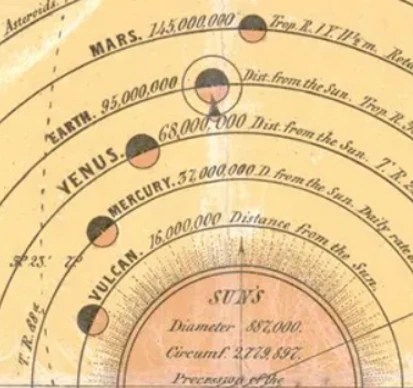
But unfortunately for Le Verrier after decades and decades of searching for Vulcan, no such planet could be found.
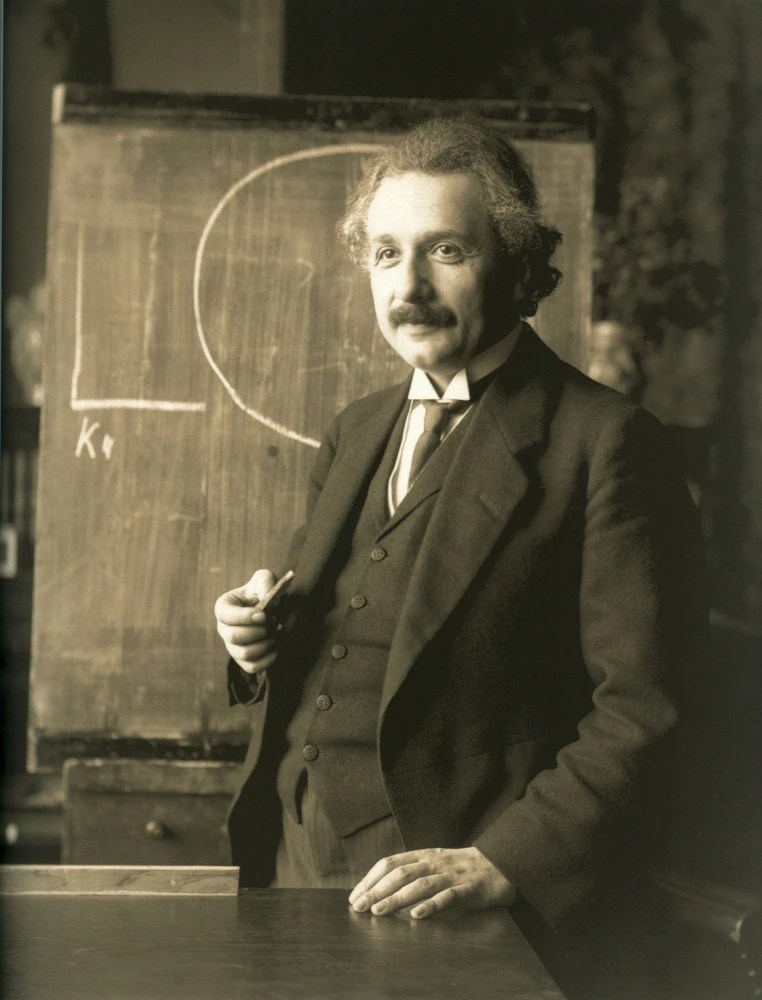
Eventually it was Albert Einstein who figured out that Newton’s laws of gravity were merely a special case of a much better theory of gravity: General Relativity. This theory has since been confirmed dozens of different ways and is the bedrock of much of our modern technology and all of our most advanced astrophysical knowledge. Vulcan was not needed anymore.

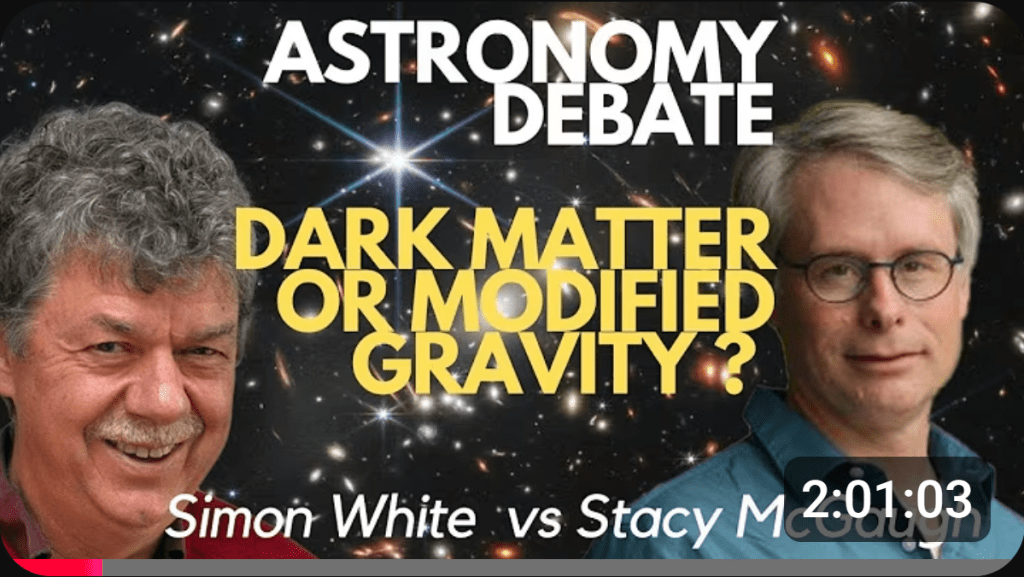
If you are interested in watching a much more detailed description of these historical precedents, you’ll enjoy this video about it:
Two solutions: modified gravity & dark matter
Modified gravity
Dark matter


- Find better equations
- Like discovering Einstein’s General Relativity
- Find more matter
- Like discovering Neptune
So these historical precedents give us the two solutions for all the weird observations in outer space. Either we find better equations to describe gravity or we find more matter to explain the observations with our current laws of gravity. The new laws would have to explain all of the discrepancies and still match other observations for which Einstein’s theory works perfectly. Alternatively the dark matter must be distributed right to explain the discrepancies but be simultaneously (mostly) invisible, hence the name “dark” matter. The rest of this blog series will cover the first of these two options, modified gravity.
Why does it matter?
Why is any of this important? Well regardless of whether these astronomical discrepancies are due to different laws of gravity or due to dark matter, they tell us we are fundamentally misunderstanding something about nature. And historically once a breakthrough is achieved on such nebulous and mysterious topics this is followed by a giant leap in technological understanding. Anything from lasers and GPS to clean solar energy and cancer treatments is based on breakthroughs such as relativity and quantum mechanics. Who knows what can be possible!



 Continental Hotspot
Leave a reply to 2. What is MOND? – Continental Hotspot Cancel reply