
A really really common misconception about MOND is that Milgrom’s constant a0 is a “minimum acceleration”. In other words, no acceleration could be lower than a0. This is very much not how MOND works. In fact all of the interesting things MOND describes that differ from Newtonian gravity occur at gravitational accelerations below a0.
It becomes clear that this idea of a “minimum acceleration” is wrong by looking at a graph we’ve seen before:
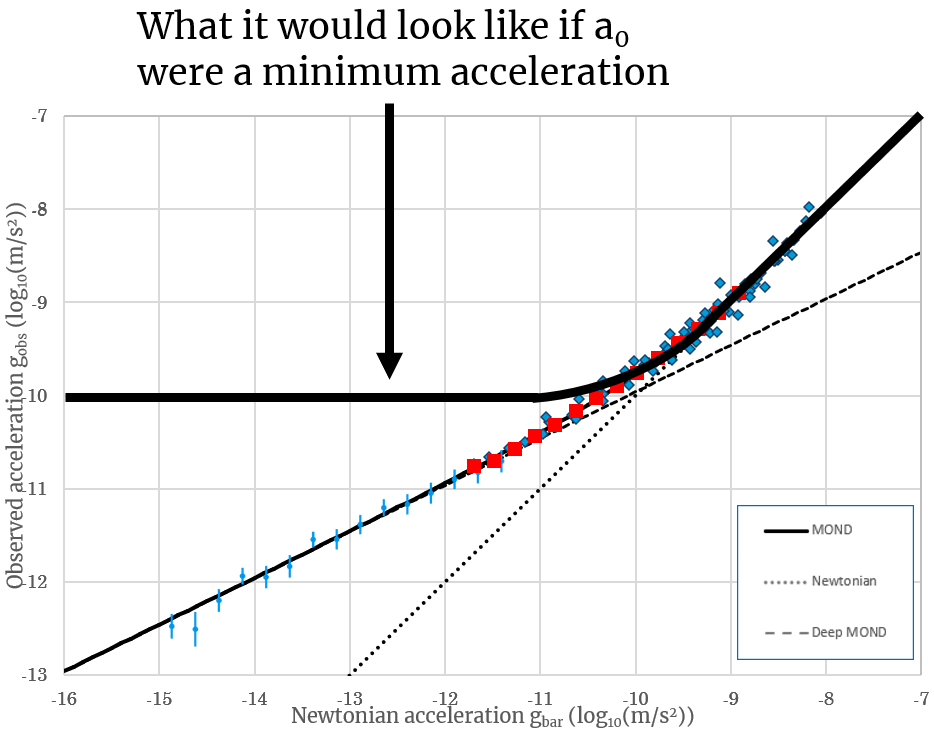
Most galaxies have internal gravitational accelerations that are well below a0 and the data from weak lensing is up to several hundred times smaller. A minimum acceleration would also not match the observations of flat rotation curves because it would actually imply rising rotation curves.
Of course it does sting when a pundit with a large audience confidently declares MOND to be a complete failure while said pundit fails to understand its most basic concept. But it is not just the popular media. This misconception can also be found in plenty of scientific literature. See below to see the MOND Hall of Shame for the examples I could find:
In a sense this misconception gives us a useful shortcut for evaluating the relevance of a popular or scientific publication. If it contains this misconception it is abundantly clear the author doesn’t know what he or she is talking about so such a publication can be safely ignored.
Perhaps this mistake occurs because people associate MOND with quantum mechanics which tends to have minimum possible values for classical quantities. MOND may well ultimately be the result of some sort of quantum gravity shenanigans but one should not think that gravitational accelerations are quantised in MOND. All the different versions of Milgromian dynamics are still classical theories. I’m sure someone came up with a pet theory where this isn’t the case but that is no longer the theory of gravity that Milgrom proposed.




 Continental Hotspot
Leave a reply to Manuel Cancel reply