
Milgromian dynamics has been declared dead many many times since it was first proposed by Milgrom in 1983 even as the number of people who support it has continued to grow. You can find commentary calling MOND a “zombie theory”. This extends not just to online commentary but also to reactions by eminent scholars in physics and astronomy. To quote theoretical astrophysicist David Spergel:
“We should keep in mind that MOND has a long history of failures. It’s a bit like.. It’s one of these theories that its proponents seem to refuse to give up despite its lack of success on so many different scales.”
Let’s divide the falsification claims into two groups. Those that have been debunked in rebuttals and those that are genuine problems.
False negatives: The misuse of data in MOND critiques
Most falsification claims arise due to researchers not taking the time to read up on and understand MOND properly. A problem that also occurs when the authors intend to support MOND (see the MOND hall of shame). For example this results in analysing rotation curves incorrectly (using Vmax or simply the last datapoint instead of Vflat) and consequently claiming the galaxy does not fall on the BTFR. Or by ignoring the external field effect or the effect of tides. If you intend to falsify MOND, great! But read the theory first if you want to be successful.
After a couple decades of that we now have a large number of published papers claiming to falsify MOND only to be rebutted some time later in different papers correcting their methodology. Srikanth Togere Nagesh has done an amazing amount of work in compiling a list of these claimed falsifications and rebuttals which you can find below. There is also an associated post on professor Kroupa’s blog.
Serious falsification claims
Some of these falsification claims have merit. X-ray emitting systems, in particular galaxy clusters, pose a real problem for MOND that has been around for most of MOND’s existence. The data should be on the black curve but they aren’t:
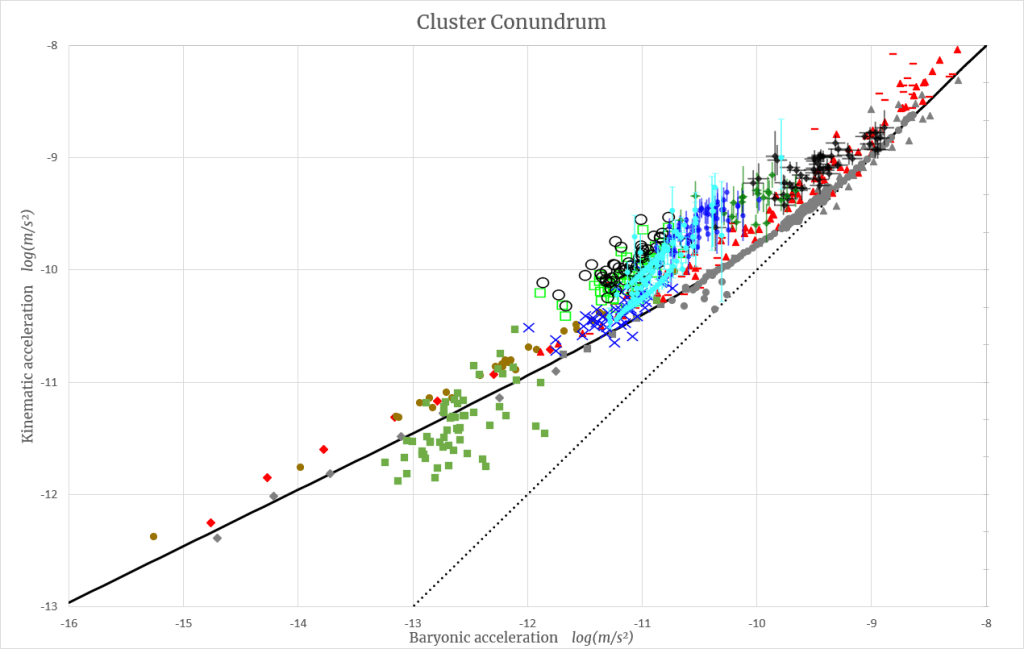
Maybe that’s fixable if people are wrong about the amount of hydrostatic bias in X-ray analyses. But until someone actually proves that with a decent study, this is why MOND is a marginal position. An excellent paper to this effect is “Problems for MOND in Clusters and the Ly-alpha Forest” by Aguirre et al. 2001. This is what MOND should do, this is what it has claimed to do since 1983, and is what it fails to do when checking against the data.
Other criticisms rely on MOND not being a relativistic theory and therefore not being able to explain data that rely centrally on relativistic effects such as most datasets in cosmology. The absence of a CMB prediction for example. In this sense all relativistic datasets falsify Newtonian gravity and since MOND is a modification of that they also falsify MOND.
When judging MOND on the later cases one may want to keep in mind the commentary of famous philosopher of science Imre Lakatos:
Now, Newton’s theory of gravitation, Einstein’s relativity theory, quantum mechanics, Marxism, Freudianism [the last two stock examples of bad science or pseudo-science for Popperians], are all research programmes, each with a characteristic hard core stubbornly defended, each with its more flexible protective belt and each with its elaborate problem-solving machinery. Each of them, at any stage of its development, has unsolved problems and undigested anomalies. All theories, in this sense, are born refuted and die refuted. But are they [all] equally good?




 Continental Hotspot
Leave a Reply