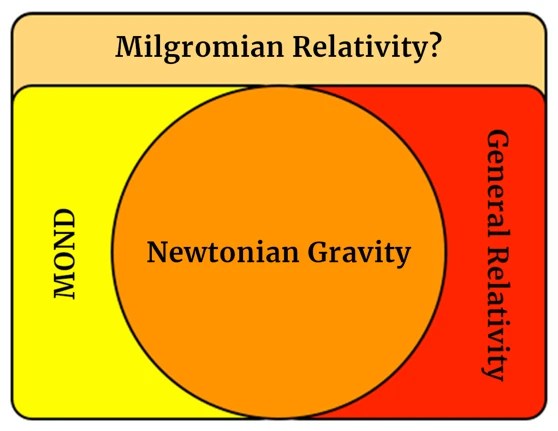
Yes, indeed MOND as proposed by Milgrom (either the AQUAL or the QUMOND formulation) is not a relativistic theory and cannot explain relativistic phenomena like gravitational lensing or the expansion of the universe. That doesn’t mean it is not a “real” theory. MOND contains Newtonian gravity and gives new behaviour when gravitational field strengths drop below Milgrom’s constant a0. In this sense Milgromian dynamics is just as real as Newtonian dynamics or general relativity, just in it’s own applicable domain:

MOND applies when:

\dfrac{\phi}{c^2}<<1
\dfrac{v^2}{c^2}<<1

GR applies when:

g_{bar}=\nabla\phi>>a_0

To put that more visually we can draw the relation between MOND, Newtonian gravity and general relativity like the diagram below.
Proposals for Milgromian relativity

Famaey and McGaugh have done an amazing job of summarizing the various proposals for a Milgromian relativity which seek to combine MOND and GR. I won’t try to rehash what they’ve written but simply refer you to chapter 7 of their review:

Modified Newtonian Dynamics (MOND): Observational Phenomenology and Relativistic Extensions, Chapter 7 Relativistic MOND Theories

Some of these proposals, in particular TeVeS which was the most popular for a time, have since been ruled out by gravitational wave event GW170817 which showed that gravitational waves travel at the speed of light. However other relativistic MOND theories manage to satisfy this criterion such as bimetric MOND by Milgrom and a preferred frame theory by Sanders.

Recently it has been shown that at least one relativistic MOND proposal by Skordis and Złosnik can fit the CMB and the matter power spectra.

Whether any of these extensions of GR which seek to incorporate Milgromian dynamics instead of dark matter will stand the test of time remains to be seen. It is hard to out-Einstein Einstein.

And yet relativistic observations look like MOND

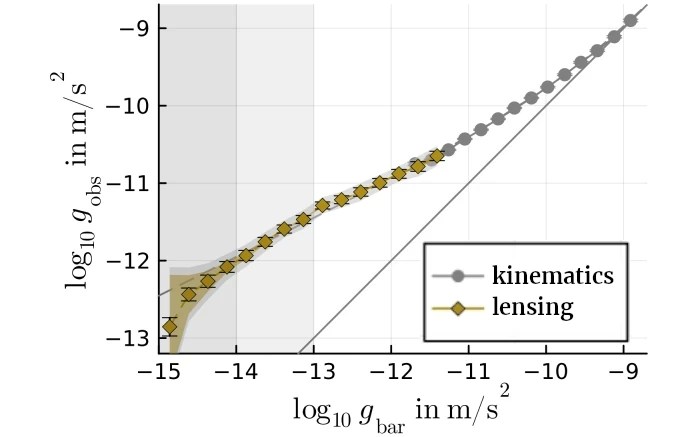
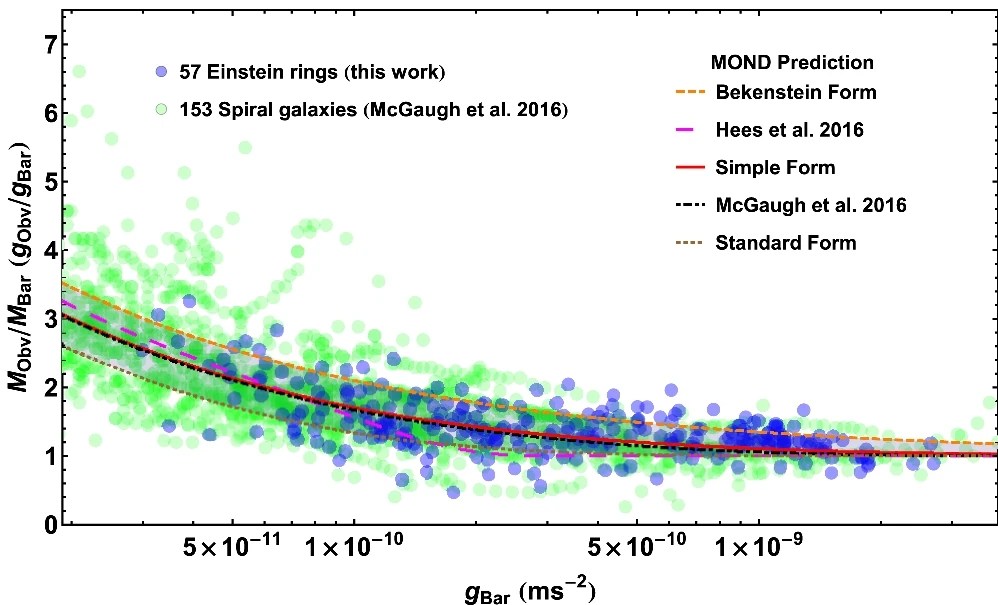
While no theory of Milgromian relativity exists, when we check relativistic phenomena that occur in MOND’s regime of applicability we find that GR and MOND agree. The most impressive result is that from weak lensing which extends Milgrom’s law/the radial acceleration relation by many orders of magnitude:

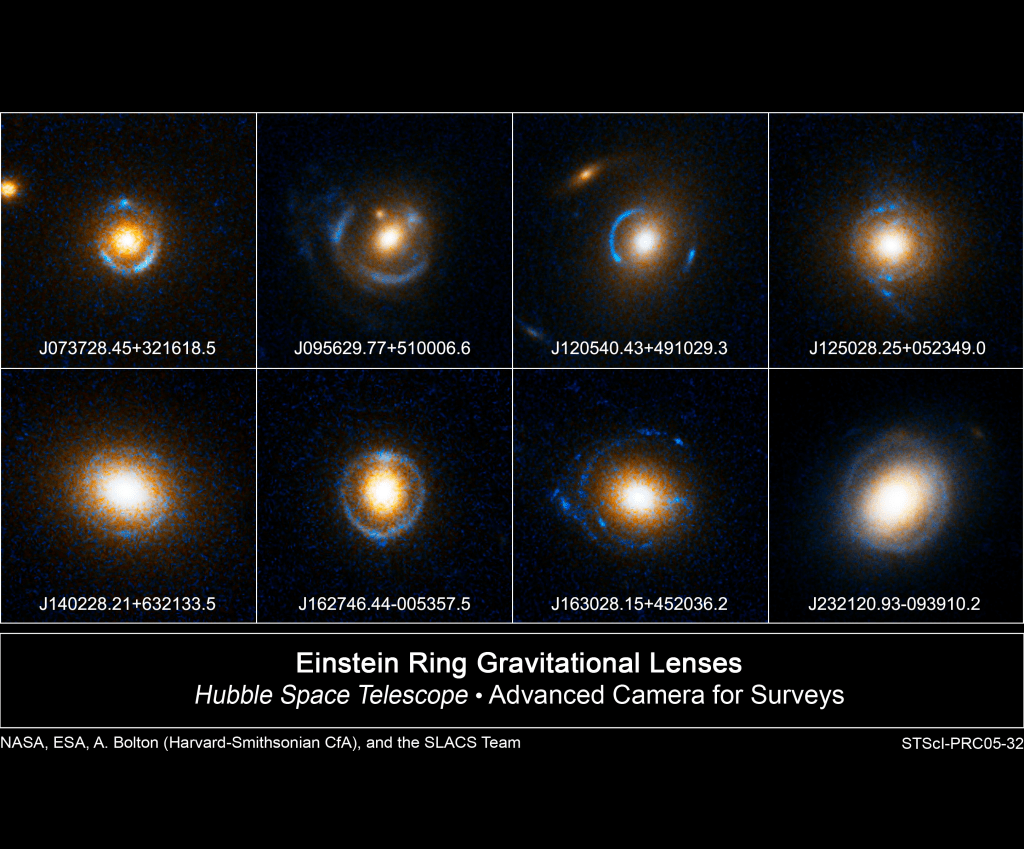
But this isn’t the only case in point. Strong lensing from Einstein rings as analysed by Tian and Ko (2017) shows similar agreement:
4 responses to “23. MOND isn’t a real relativistic theory though right?”

  1. …the highly successful LCDM…

    I don’t understand why you would say such a thing. By any rational assessment the LCDM model is a scientific trainwreck. Observations do not support any of the claims LCDM makes upon physical reality. The physical reality we observe, measure, and directly detect does not contain singularities, an inflation event, a big bang event, expanding spacetime, dark matter, or dark energy.

    The inexplicable initial singularity and big bang are creation myths – mathematical consequences of the expanding universe assumption underlying the FLRW equations which form the basis of all modern cosmologies. The other elements are ad hoc additions attributed to physical reality which try to force fit physical reality to the naive belief that our gravitational models (Newton/Einstein), derived in the Solar System, are “universal laws”.

    In order to believe in the LCDM model you have to believe in the existence of things that have no empirical evidence supporting their existence. LCDM cosmology is a creation myth with a heavy dose of circular-reasoning-based metaphysics. It is not a scientific model; it is nonsense that should have been relegated years ago to the same dustbin of history that contains geocentric cosmology.

    Like

    1. Hi! Welcome to my FAQ blog 🙂

      The way I see it all models are wrong but some are useful. Given the evidence against LCDM I don’t think it can be true as a fundamental description of reality. It is however a very good fitting function for cosmological datasets. It has only half a dozen free parameters yet it contains a great deal of predictive power. For example using LCDM one could calculate the polarization of the CMB from its power spectrum and vice versa. Or use the CMB to predict the BAO peak in the clustering correlation function. In this way LCDM makes other measurements possible such as the Brouwer’s weak lensing RAR (based on the WMAP 9-year LCDM cosmological parameters).

      Your comparison to geocentrism with its epicycles is apt if harsh (far more epicycle parameters were necessary to fit the solar system than the number of free parameters in LCDM). Geocentrism was wrong but you could use it to generate accurate predictions for the movements of planets with reasonable precision. In my opinion therefore the likes of Ptolemy and Tycho Brahe were doing science, even though their model was superseded by a better one in the end.

      By your standard MOND would also be a “scientific trainwreck” because it is resoundingly falsified by all relativistic phenomena (which MOND, i.e. AQUAL/QUMOND, does not allow).

      Like

      1. Note: This discussion pertains to a paragraph I moved to a separate article: 30. Can MOND do cosmology yet?

        Like

  2. Hi Mark,

    The utility of a model is of secondary importance to its explanatory power. I would say that all models are incomplete but some are approximately correct while others are just wrong. The obvious example is once again Ptolemaic cosmology which remained useful even after the advent of heliocentrism. It was nonetheless a completely erroneous representation of physical reality. Ptolemaic cosmology remains a useful calculational tool but it is/was a scientific dead-end.

    The analogy between Ptolemaic cosmology and the expanding universe model is a tight one in the sense that both are based on erroneous conceptions about a the nature of physical reality. The Earth is not the center of the Solar System. let alone the Cosmos and the Cosmos is not a Universe, meaning that it is not the unified, coherent, simultaneously existing entity that LCDM depicts. The giant expanding gas bag model of FLRW (the basis of LCDM) is the geocentrism of modern cosmology. The redshift=recessional-velocity assumption is analogous to the perfect circle conceit.

    There are two well known scientific facts that refute the expanding universe model:

    1. The maximum speed of light is 3×10^8 meters per second.
    2. Our current cosmological observations extend to galaxies in excess of 10 billion lightyears distant in all directions and the closest galaxy to us is 2.5 million lightyears away.

    Given those facts it is impossible for us to have any knowledge of the current state of any one of the galaxies we observe. It follows that we cannot and do not have any knowledge of the “current state” of the Cosmos that surrounds us. The current state of the Cosmos is a scientifically meaningless concept. “Now” has only an approximate local meaning.

    The existence of a simultaneously existing Universe as assumed by FLRW is simply ruled out by known physics. Math is not physics and model fitting exercises do not alter the facts. The standard model of cosmology has no scientific basis; cosmology will not be a science until it jettisons the expanding universe model and starts to study the Cosmos as it is, rather than wasting years trying to backfit cosmological reality to a fundamentally broken model.

    The good thing about MOND is that it clearly demonstrates that our gravitational models (Newton/Einstein), derived in the context of the Solar System, are not universal laws. MOND itself was developed in the context of spiral galaxies and is also clearly not a universal law. MOND is also not a cosmology – it’s just some math, useful for calculations but uninformative regarding physics.

    Like

Leave a reply to budrap Cancel reply

Trending