Yes, indeed MOND as proposed by Milgrom (either the AQUAL or the QUMOND formulation) is not a relativistic theory and cannot explain relativistic phenomena like gravitational lensing or the expansion of the universe. That doesn’t mean it is not a “real” theory. MOND contains Newtonian gravity and gives new behaviour when gravitational field strengths drop below Milgrom’s constant a0. In this sense Milgromian dynamics is just as real as Newtonian dynamics or general relativity, just in it’s own applicable domain:
MOND applies when:


GR applies when:

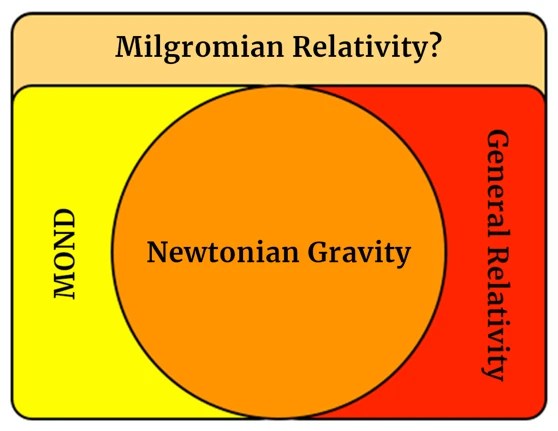
To put that more visually we can draw the relation between MOND, Newtonian gravity and general relativity like the diagram below.
Proposals for Milgromian relativity
Famaey and McGaugh have done an amazing job of summarizing the various proposals for a Milgromian relativity which seek to combine MOND and GR. I won’t try to rehash what they’ve written but simply refer you to chapter 7 of their review:
Some of these proposals, in particular TeVeS which was the most popular for a time, have since been ruled out by gravitational wave event GW170817 which showed that gravitational waves travel at the speed of light. However other relativistic MOND theories manage to satisfy this criterion such as bimetric MOND by Milgrom and a preferred frame theory by Sanders.
Recently it has been shown that at least one relativistic MOND proposal by Skordis and Złosnik can fit the CMB and the matter power spectra.
Whether any of these extensions of GR which seek to incorporate Milgromian dynamics instead of dark matter will stand the test of time remains to be seen. It is hard to out-Einstein Einstein.
And yet relativistic observations look like MOND
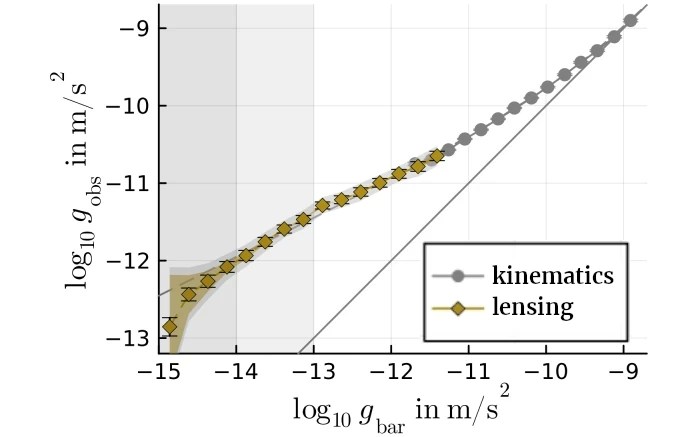
While no theory of Milgromian relativity exists, when we check relativistic phenomena that occur in MOND’s regime of applicability we find that GR and MOND agree. The most impressive result is that from weak lensing which extends Milgrom’s law/the radial acceleration relation by many orders of magnitude:
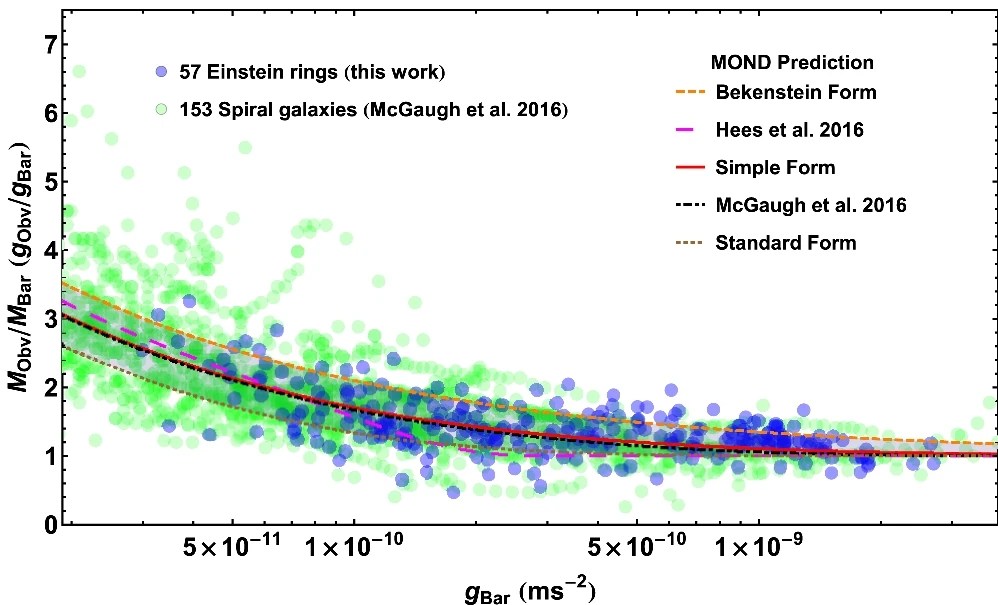
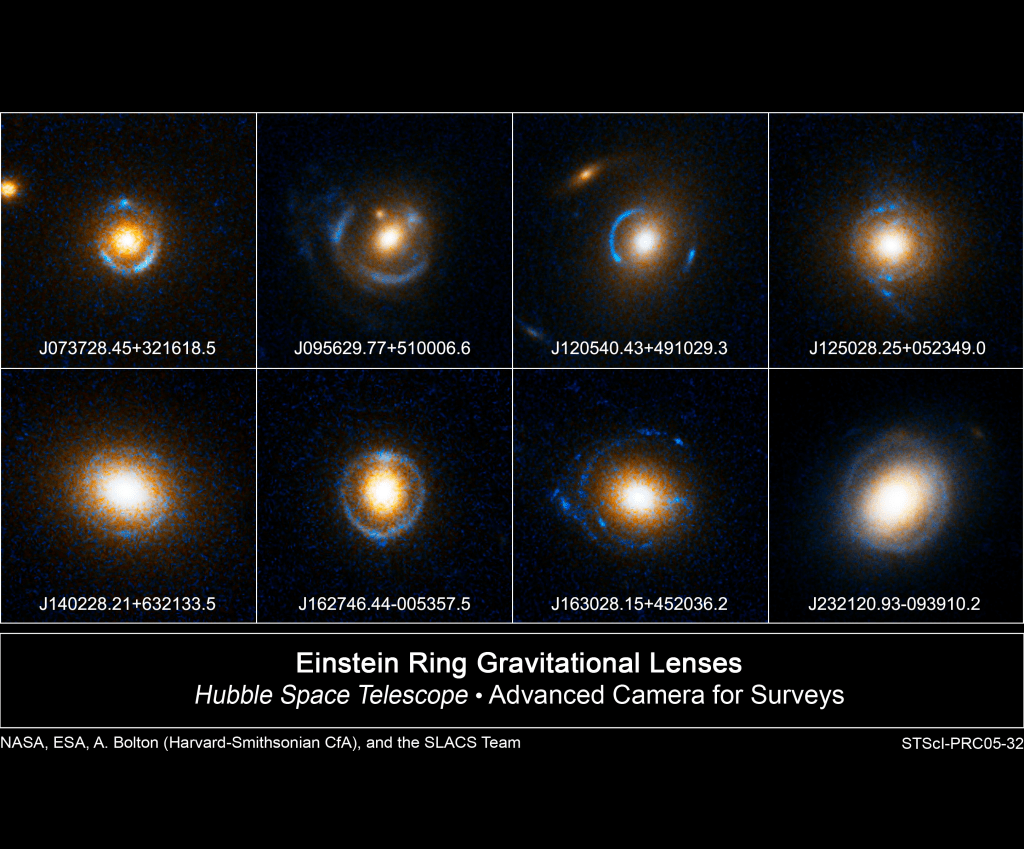
But this isn’t the only case in point. Strong lensing from Einstein rings as analysed by Tian and Ko (2017) shows similar agreement:




 Continental Hotspot
Leave a Reply